Lukang 鹿港: Old Street, temples and buses from Taichung
Travel to Lukang from Taichung by shuttle bus. Explore Lukang Old Street, Longshan Temple, Tianhou Temple, narrow lanes, and the Folk Arts Museum.
To reach Lukang (鹿港) from Taichung, catch Taiwan Tourist Shuttle bus 6936 or the 6936A express directly from HSR Taichung Station. Both routes take you to the Lukang stop, which puts you right next to historic brick alleys, major temples, and traditional crafts. Lukang makes a straightforward day trip from Taichung or when exploring central Taiwan.
The shuttle bus from HSR Taichung
Taiwan Tourist Shuttle 6936, the Lukang Blessing route (鹿港祈福線), runs from HSR Taichung Station through Changhua (彰化) and Lukang to the Taiwan Glass Gallery. Fares are charged by distance from HSR Taichung Station. At the high-speed rail station, the shuttle boards in the first-floor bus area at Exit 5, Platform 5. For both Lukang Old Street and Lukang Longshan Temple (龍山寺), get off at the Lukang stop (彰化客運鹿港站, the Changhua Bus Lukang station).
On weekdays, the Lukang Blessing route timetable lists departures from HSR Taichung at 08:00, 10:00, 12:00, 14:00, 16:00, and 18:00. The 08:00 bus calls at Changhua railway station at 08:27 and reaches the Lukang stop at 09:05. The holiday timetable adds extra morning and afternoon departures from HSR Taichung at 11:00 and 15:00.
Returning from the Lukang stop, weekday buses leave at 10:16, 12:16, 14:16, 16:16, and 18:16. The 10:16 service reaches Changhua railway station at 11:00 and HSR Taichung at 11:25. The holiday schedule adds departures at 13:16 and 17:16.
Paying in cash, the full fare from HSR Taichung to the Lukang stop is NT$82 (NT$41 half fare), and from Changhua railway station it is NT$48. If you tap an IC card, the fare is NT$72 from the high-speed rail station and NT$42 from Changhua. On board, you can pay in cash, with an EasyCard, iPASS, or icash card, or by mobile payment. Tickets are also sold at Changhua Bus counters in Changhua and at the Lukang stop. Up to two children under 115 cm ride free when traveling with a paying adult.
The faster 6936A and buses from Changhua
The 6936A Lukang Blessing Express runs along the national freeway. Because it uses the freeway, standing passengers are not permitted, and travelers board strictly in line. If a bus fills up, you must wait for the next service or switch to route 6936. Booking a seat in advance with Changhua Bus is advised.
On weekdays, the 6936A leaves HSR Taichung at 09:00, 13:00, and 17:00, reaching the Lukang stop 35 minutes later at 09:35, 13:35, and 17:35. The holiday timetable adds an 08:20 departure that arrives at Lukang at 08:55. Returning to Taichung, the express leaves the Lukang stop on weekdays at 11:16, 15:16, and 19:16, pulling into HSR Taichung at 12:00, 16:00, and 20:00. The holiday timetable adds a 09:51 run.
For the express, the cash fare from HSR Taichung to the Lukang stop is NT$71 (NT$35 half fare), or NT$62 when paying with an IC card. You can learn more about cards and fares in our guide to Taiwan money and public transport via getting around Taiwan.
If you are traveling locally within Changhua County, the township office lists regular Changhua Bus routes 6900, 6901, 6902, and 6934 linking Changhua and Lukang. Changhua Bus 6933 also runs between Lukang, Changhua, HSR Taichung Station, and central Taichung.
Lukang Old Street
Lukang Old Street refers broadly to Yaolin Street (瑤林街) and Putou Street (埔頭街). Lukang was a busy trading port, and this district became the first area in Taiwan designated for historic preservation. In the past, the street functioned as a river port where boats tied up directly behind the houses to unload cargo while shops traded out front.
Yaolin Street is the shortest stretch among the historic lanes, measuring just 30 m long. Putou Street begins right past the bend at the end of Yaolin Street. Its sharp zigzag layout was designed deliberately to break the force of harsh autumn winds and hinder fleeing thieves. Today, more than 90% of the historic townhouses are leased to local businesses. You will find shops selling long-made traditional confections, flour tea, mullet roe, and handicrafts, alongside working craft workshops specializing in wood carving, ceramics, jade, gold, tin, and dough figurines. The county tourism site lists opening hours for Lukang Old Street from 10:00 to 18:00, though individual shop hours vary.
Two notable landmarks sit along these paths:
- Half-Side Well: Situated on Yaolin Street, this stone well was built half inside a private residence's wall and half outside on the lane so that passing neighbors and travelers could draw fresh water.
- Lukang Assembly Hall: Located at 72 Putou Street, this building combines Japanese and Western architectural elements. Erected in 1928 over the grounds of an earlier temple, it serves today as a public arts and exhibition hall. The Lukang Township Office lists its opening hours as Tuesday through Friday from 09:00 to 17:00, and Saturday through Sunday from 10:00 to 18:00. It is closed on Mondays and Lunar New Year's Eve.
Tianhou Temple
Lukang Tianhou Temple (天后宮) sits at 430 Zhongshan Road. Designated as a national historic monument, the temple is dedicated to the sea goddess Mazu and relocated to its current grounds in 1725. During the annual pilgrimage season, which spans the first three months of the lunar calendar, dense crowds pack the halls and courtyards.
The complex is celebrated for its elaborate decorative craftsmanship, earning praise as a palace of the arts due to its painted roof beams and stone and wood carvings. Changhua County lists the temple visiting hours as 07:00 to 20:00, though temples maintain independent control over their daily schedules.
Longshan Temple
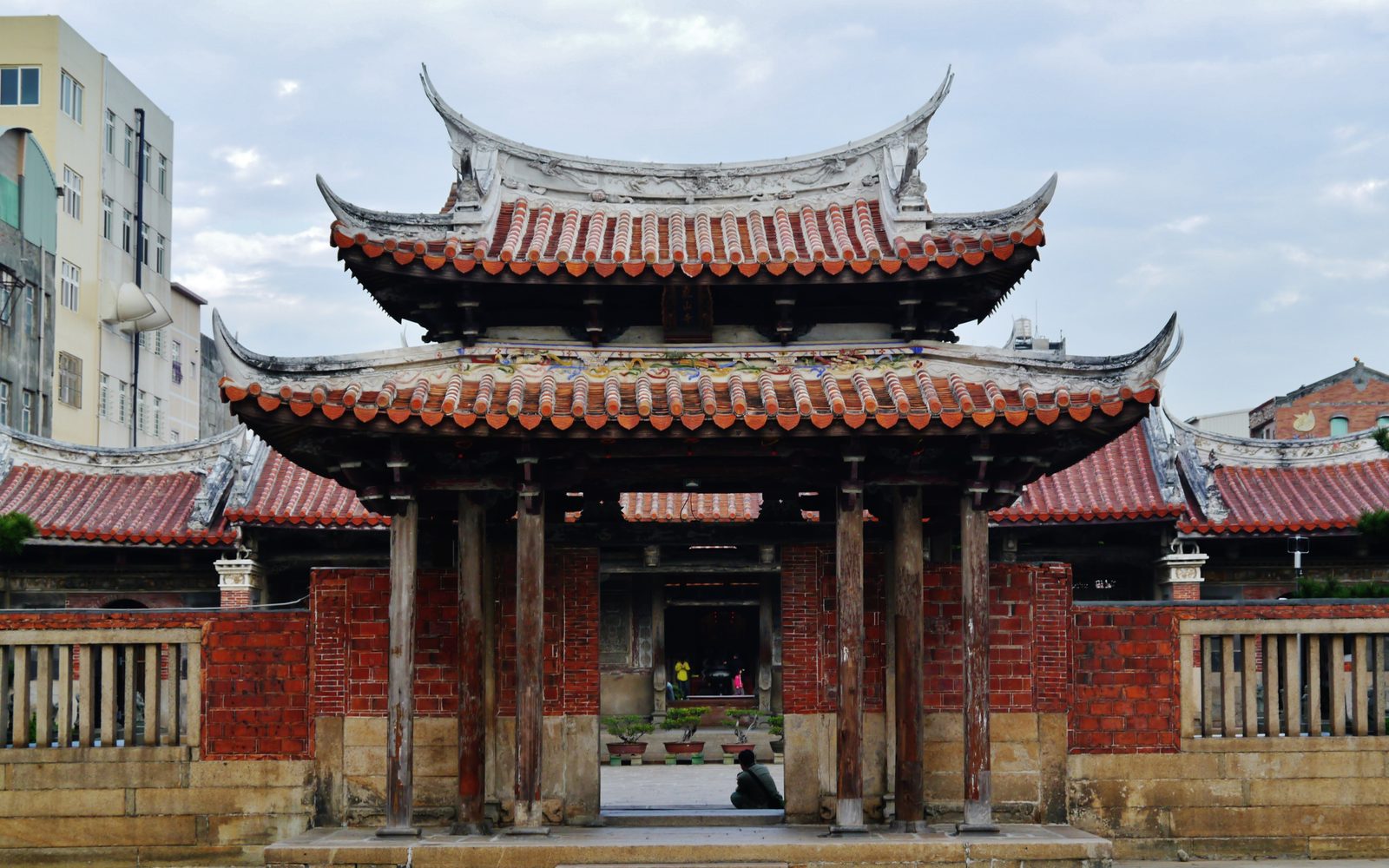
Lukang Longshan Temple is located at 100 Longshan Street, with visiting hours also listed by the county as 07:00 to 20:00. The principal deity enshrined in the main hall is Guanyin, the Buddhist goddess of mercy. The entire complex is recognized as a national historic monument.
The temple layout follows a formal plan of three halls and two courtyards. Arranged in sequence from the entrance inward, you pass through:
- The main front gate
- The Wumen Hall, containing the theatrical performance stage
- The main hall and its adjoining worship hall
- The rear hall
The highlight inside the Wumen Hall is the intricate eight-trigram caisson ceiling built over the theater stage during an 1831 reconstruction. It represents the oldest preserved caisson ceiling of its kind in Taiwan, engineered specifically to resonate and project sound during theatrical performances.
Moru Lane and Nine-Turns Lane
Moru Lane (摸乳巷) is located at 38 Caiyuan Road. It was originally built as a narrow firebreak between rows of houses, with walls placed close together to offer shelter from intense ocean winds. At its narrowest section, the passage measures under 70 cm across. The county notes that the name arose because the corridor is so narrow that two people walking past one another cannot help brushing against each other; it is also referred to as Gentleman's Lane. Moru Lane remains open around the clock.
Jinsheng Lane (金盛巷), widely known as Nine-Turns Lane (九曲巷), is an entirely separate historic passage. Located behind the southern section of Zhongshan Road, its winding red-brick corridor can be entered from Minzu Road between Nos. 163 and 167, or between Nos. 185 and 187. The "nine" in the name indicates many turns rather than an exact count. These angled walls blocked cold northeast winter monsoon gusts and kept bandits from moving freely. Today, several houses along the bricks operate as teahouses, pottery studios, and guesthouses.
Two architectural features stand out inside Nine-Turns Lane:
- Shiyilou: A high red-brick sky bridge spanning overhead across the lane, linking the rear of a residence with the building across the alleyway.
- Yilou: Located near the southern exit of the lane and reached by turning right beside 119 Zhongshan Road, known for a round lattice window shaped like gourds and antique coins.
Lukang Folk Arts Museum
The Lukang Folk Arts Museum (鹿港民俗文物館) is located at 88 Guanqian Street. The museum is open Tuesday through Sunday from 09:00 to 17:00, and is closed on Mondays.
On the county's English tourism pages, tickets are listed at NT$130 for adults and NT$70 for half fare, with free admission provided for people over 65, students, and children below kindergarten age. Visitors should verify admission categories at the counter upon arrival.
The museum grounds comprise two distinct structures. The Gufeng Building is a traditional southern Fujian-style residence dating back about two centuries, while the adjacent Western Building is an ornate Baroque-style property nearly a century old. Together, the exhibition rooms house more than 6,000 everyday historical objects documenting early clothing, food preparation, housing, tools, transport, schooling, pastimes, religious practices, and folk festivals.
Facts on this page were checked against official sources on . Hours, fares and trail status change: confirm on the day.