Sanyi 三義: wood carving, Shengxing station and rail bikes
Sanyi is Taiwan's wood-carving town. Plan a day trip for the Wood Sculpture Museum, Shengxing station, Longteng Broken Bridge, and the rail bikes.
Sanyi (三義) is the wood-carving center of Miaoli County, set along the decommissioned mountain railway track in central Taiwan. You can spend a day exploring craft workshops, visiting the island's only dedicated wood sculpture museum, and riding an electric rail bike past historical brick viaducts. It works well as an easy side trip from Taichung or as a longer day out from Taipei.
Getting to Sanyi
Local trains on the Taiwan Railway run from Taichung to Sanyi throughout the day, taking 37 to 45 minutes for NT$75 at the full fare (NT$38 for a child or senior). You can check the current schedule directly on the Taiwan Railway timetable search. Direct trains from Taipei to Sanyi are also local trains, running about once every two hours; these take 2 hours 46 minutes to 2 hours 59 minutes and cost NT$260 (NT$130 for a child or senior). If you prefer high-speed rail, take the train to Miaoli, transfer to the local railway line at the adjacent Fengfu station, and ride the train down to Sanyi. More details on ticketing systems are covered in our guide to getting around Taiwan.
Public buses operated by Hsinchu Bus run only as far as Sanyi station. To reach Shengxing station for the railway sights, the rail bike operator suggests taking a taxi or renting a scooter outside the station. The Wood Sculpture Museum is located about 2 kilometers in a straight line from Sanyi station, and there is a YouBike 2.0 station right beside the museum entrance.
Sanyi Wood Sculpture Museum
The Sanyi Wood Sculpture Museum is Taiwan's only public museum devoted to wood carving. It opened on April 9, 1995, and added a second building with display, teaching, and storage space in May 2003, which won a Taiwan architecture award that same year.
The galleries cover nine themes, including Austronesian wood carving, the history of Sanyi carving, carved architecture and furniture, temple carving, and contemporary work. The museum also hosts carving demonstrations and hands-on workshops. The Miaoli County Culture and Tourism Bureau lists the museum as open Tuesday to Sunday from 09:00 to 17:00, making it closed on Mondays. Ticket sales and entry stop half an hour before closing. Admission is listed at NT$80 full price, and NT$50 for students and Miaoli County residents. Entry is free for visitors aged 65 or over, visitors with disabilities and one companion, and children under 6.
Shuimei wood-carving street
The commercial heart of the town's craft trade is centered along Shuimei, located about 1 kilometer along Provincial Highway 3 from the Sanyi freeway exit. More than two hundred craft shops line the road, and nearly half of the township's residents make a living from wood carving. Carving shops also line Sanyi's main street.
Most of the pieces are carved from camphor, along with cypress and sandalwood. Many storefronts operate their own workshops directly behind the retail space, making Shuimei the primary market where Sanyi carvings are bought and sold. The street is open every day, though individual shops set their own hours.
Shengxing station and the old line
The old mountain railway line was completed in 1908 and ceased regular service in 1998. At about 402 meters above sea level, Shengxing station was the highest point on the western main line. The station stands on a small terrace in a mountain valley, built entirely of wood without a single nail used in its structural posts.
Passengers riding the A-route rail bike stop at Shengxing for about 40 minutes, which leaves enough time to listen to the guided talk or walk along Shengxing Old Street. Further along the line sit Tunnels 3 through 6, a sequence of short, straight tunnels lined up so you can look through them all at once; these were rebuilt in concrete after the great earthquake of 1935.
Longteng Broken Bridge
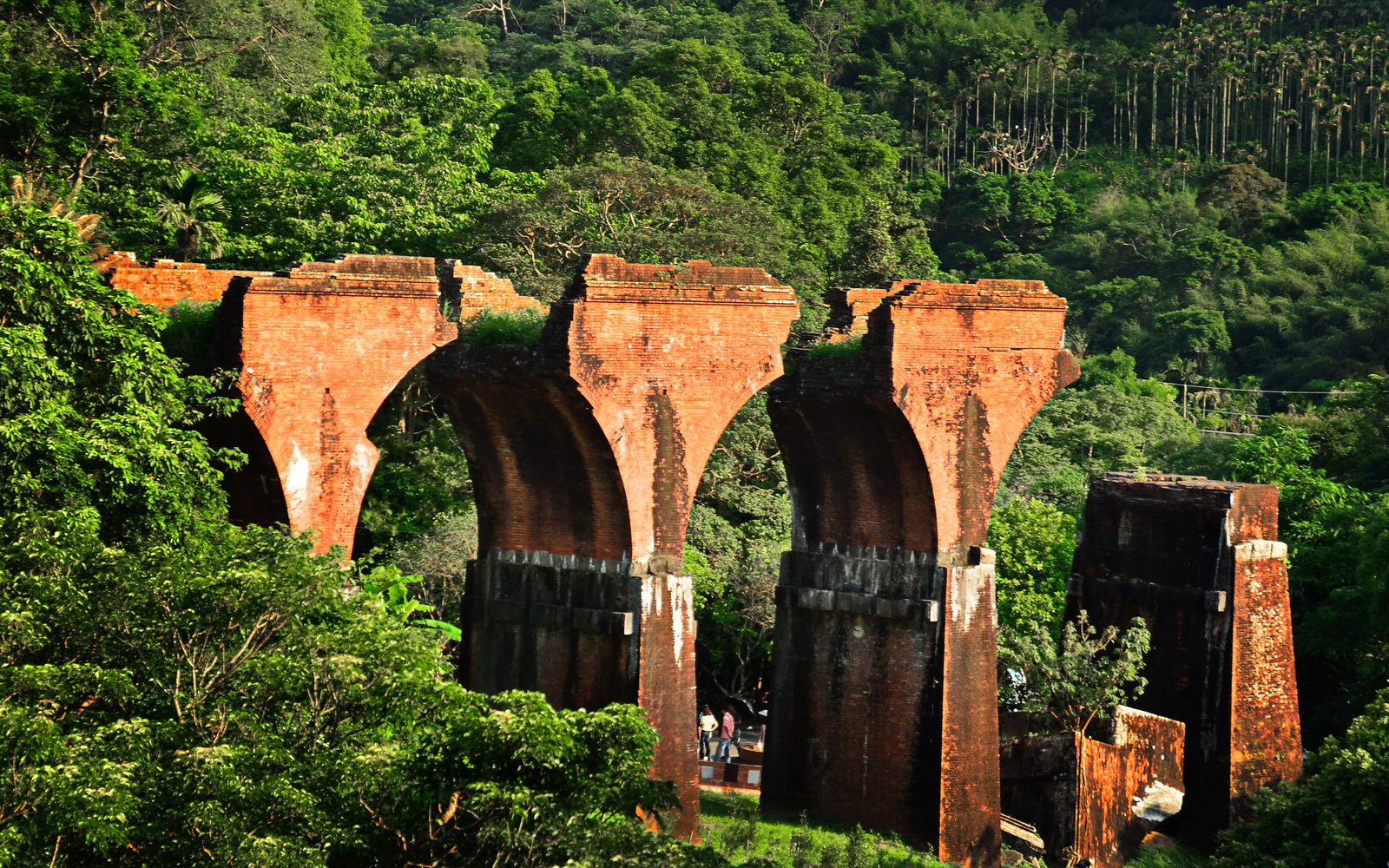
The Longteng Broken Bridge stands over Longteng Creek about two kilometers past Shengxing, showing a row of tall brick arches directly beside the old track. The bridge was built around 1905, assembled using red brick and mortar without structural steel. The masonry was exceptionally solid—villagers who later attempted to salvage bricks from fallen sections rarely managed to retrieve more than a dozen whole bricks in a single day.
In the early morning of April 21, 1935, a great earthquake centered near Guandaoshan destroyed the crossing. A replacement bridge was constructed to the west, leaving the ruined arches standing in place. The site is open every day for visitors to view.
The rail bikes
Miaoli County preserved the abandoned track by converting it into the Old Mountain Line rail bike, the first attraction of its kind on the island, and the route has earned certification from the international slow-city movement. Each four-seat car features an electric motor to assist with pedaling and includes a GPS audio guide. The system operates three main routes described on the Old Mountain Line Rail Bike ride information page:
- Route A: Runs from Shengxing station to the South Broken Bridge over the Yutengping bridge. The ride takes 70 to 80 minutes including the guided talk, costing NT$285 per person (NT$230 for a child). Departures from Shengxing leave at 09:20, 11:20, 13:50, and 15:50, with a fifth departure at 17:30 on holidays from April. Tickets must be picked up by 09:00, 11:00, 13:30, and 15:30 respectively.
- Route B: Runs from Longteng station to Shengxing without crossing the Yutengping bridge. The excursion takes 70 to 80 minutes and costs NT$230 per person (NT$185 for a child).
- Route C: Runs from Longteng station across the Yutengping bridge to Tunnel 6, lasting 70 to 80 minutes at NT$285 per person (NT$230 for a child).
The Yutengping railway bridge stands 33 meters high, offering elevated views looking directly down onto the Longteng Broken Bridge.
Tickets can be booked online up to 90 days in advance starting at 10:00, with web bookings closing two hours before departure time. A single order can reserve up to 30 tickets; since each vehicle seats four people, you must purchase four tickets if you want an entire car to yourselves. You must pick up your paper ticket with its QR code at least 30 minutes before your scheduled departure and attend the mandatory safety briefing 20 minutes prior. Boarding check-in closes 10 minutes before the car departs.
Children under 3 years of age or under 95 cm in height cannot ride. The child fare applies to passengers aged 3 and older but under 7 who measure at least 95 cm; foreign travelers show a passport to verify eligibility. The driver of the rail bike must be at least 12 years old. Because the route includes elevated crossings, climbs, and dark tunnels, pregnant visitors cannot ride, and guests with a fear of heights or heart conditions must assess the conditions for themselves.
Tung blossom season
Miaoli County notes that the tung blossom season spans April and May each year across county viewing spots, making it a popular window to consider when planning the best time to visit Taiwan. The white blossoms fall in drifts resembling snow, and the flowering period lasts about two months through the end of May.
Tung trees historically flourished in areas settled by Hakka families, and the flower remains deeply tied to regional Hakka culture, celebrated during the county's annual Hakka tung blossom festival. In Sanyi, local viewing centers along County Road 49, where the red masonry piers of the Longteng Broken Bridge rise over walking paths covered in fallen white petals. The Tiaotan Old Trail in Sanyi also features some of the area's densest tung blossom canopies.
Facts on this page were checked against official sources on . Hours, fares and trail status change: confirm on the day.