Penghu 澎湖: flights, ferries, fireworks and sights
Daily domestic flights to Penghu run year-round from five cities, while passenger ferries from Kaohsiung and Chiayi operate mainly in the calmer spring-to-autumn months. Checked .
Penghu (澎湖) is reached by daily domestic flights from five cities on Taiwan's main island or by ferry across the Taiwan Strait. Summer brings calm seas, clear night skies, and the ocean fireworks festival, while the winter months bring strong winds from the northeast monsoon. Once on the main islands, local tour buses and linked highways connect basalt formations, coastal viewpoints, and tidal paths.
Penghu at a glance
Penghu is a group of about 90 islands and islets, with only 19 of them lived on. Together, they make up about 128 square kilometers of land, surrounded by 320 kilometers of winding coastline. The largest islands, in order of size, are the main island with Magong (馬公), Xiyu (西嶼), Baisha (白沙), Qimei (七美), and Wang'an (望安). These islands took their first form 8 million to 17 million years ago from lava that cooled and hardened, shaped over time by wind and sea waves.
Flying to Magong
More than 30 flights link Penghu with Taipei, Taichung, Tainan, Chiayi, and Kaohsiung, and airlines add more flights during peak travel seasons and holiday periods. UNI Air operates flights to Penghu from Taipei, Taichung, Tainan, Kaohsiung, Chiayi, and Kinmen. Mandarin Airlines flies to Penghu from Taipei, Taichung, and Kaohsiung. Domestic air travel connects through the wider transport network covered in our guide to getting around Taiwan.
According to scheduled timetables at Penghu Airport, flight durations are short:
- From Taipei: Magong airport blocks an hour, such as a 06:35 departure arriving at 07:35.
- From Taichung: The table blocks 45 minutes, such as a 10:45 departure arriving at 11:30.
- From Kaohsiung: The table blocks about 40 minutes, such as an 11:40 departure arriving at 12:20.
- From Tainan: The table blocks 30 minutes, such as a 15:00 departure arriving at 15:30.
- From Chiayi: The table lists a UNI Air flight departing at 16:25 and arriving at 17:00.
The ferry from Kaohsiung
The Penghu ferry, operated by Taiwan Navigation between Kaohsiung and Magong, is a roll-on roll-off passenger and car ship built to carry 600 passengers. On board, the ship provides private cabins, 60 four-berth sleeper cabins, 60 business seats, and 240 economy seats, along with a cafe and a family room. The ship was built in Japan and made its first run from Kaohsiung to Magong on September 5, 2023. Unlike light passenger boats, its broad hull makes it less limited by sea conditions during the winter northeast monsoon.
The Penghu National Scenic Area gives the crossing time between Kaohsiung and Magong as about four hours, noting that night sailings run in the summer as well. The operator suggests travelers coming from the west or south of Taiwan ride the high-speed rail to Kaohsiung and head straight to the harbor. If you are spending time in the departure port before sailing, see our guide to Kaohsiung.
In the November and December timetable, most sailings from Kaohsiung depart at 23:30 on Wednesdays and Fridays, with a few departures at 09:00 on Mondays. Most return sailings from Penghu depart at 15:30 on Thursdays and Sundays, with some leaving at 16:00. These sailing times can change if weather shifts, and the notice posted at the port takes priority.
Tickets can be booked online starting 56 days ahead up until 4 hours before departure. If you buy tickets at the harbor counter, do so at least an hour before sailing, as walk-in passengers without reservations may find the ship fully booked. Ticket sales close 30 minutes before departure for loading and security checks. When purchasing or collecting tickets, you must present identification for every passenger, which means a passport for international visitors. The ferry departs from Pier 1 at Kaohsiung port for now; its move to Pier 8 has been put back to May 2027, with the exact date to be announced.
Fast boats from Budai (summer only)
Light fast passenger boats run between Budai (布袋) port in Chiayi and Magong only during the summer season. The sea crossing takes about 90 minutes, with schedules shifting depending on the season and local weather. The scenic area lists three operators on the Budai route: All Star, Kaixuan, and Pescadores Ferry, which sails the Blue Magpie and the Clouded Leopard. Because of rough winter seas brought by the northeast monsoon, the Budai-Magong fast boats stopped running on October 12, 2026, and remain suspended until mid-March 2027, with 2027 start dates to be announced later.
When to go, and the winter wind
While summer is the busiest period, the scenic area notes that Penghu is not only for April to September, as the rest of the year brings comfortable temperatures and smaller crowds. For a wider look at island weather patterns, read about the best time to visit Taiwan. In spring, migratory terns arrive across the region, and boat trips heading into the south and east waters pass basalt cliffs with flocks flying overhead. Summer offers clear night skies for stargazing thanks to lower light pollution than Taiwan's main island, and it is the ideal time to view the stone fish weirs around Jibei (吉貝).
Summer days are very hot and dry. The scenic area advises visitors to bring sunscreen, sunglasses, a hat, and a UV-blocking umbrella, and to wear breathable long sleeves. From early November through March, the northeast monsoon brings strong winds and larger waves, requiring extra caution on boats. Winter winds can be intense near coastal lookouts, so do not stand close to cliff edges. Over time, these persistent winds have weathered exposed shoreline rock into onion-like layers, which can be seen at Xiaomen on Xiyu.
The ocean fireworks festival
The ocean fireworks festival has been organized by Penghu County Government every summer since 2003, turning into one of the island group's major summer draws. The festival usually runs from about May to July around Guanyinting (觀音亭) park and across several outer islands. Displays are set off over the bay against the backdrop of the Xiying Rainbow Bridge, accompanied by stage performances from local and invited performers.
The main viewing areas on land are the sea wall, Guanyinting park, and the Xiying Rainbow Bridge in Magong, while evening boat trips also take spectators out onto the bay. Daily show times are decided and updated by Penghu County Government. For a quiet daytime escape before an evening fireworks show, the scenic area suggests exploring the rural countryside and quiet shorelines of Huxi (湖西).
In 2026, the festival featured 33 shows, running on Mondays and Thursdays from May 4 to June 25, followed by Tuesday shows from June 30 to August 25. Along with the main waterfront shows at Guanyinting, the 2026 event staged outer-island shows on Wang'an, Qimei, and Jibei, as well as local displays in Huxi, Xiyu, and Baisha. International fireworks teams from 6 countries participated: Japan, Malaysia, Finland, Italy, Malta, and Argentina.
The Airport Express and the Tourist Shuttle
The Penghu Airport Express (Taiwan Tourist Shuttle route 004) connects Penghu Airport directly with Magong harbor and the central bus terminal in town. It runs daily every 40 minutes between 07:20 and 20:40, with the final bus departing the airport at 20:40. A one-way ride costs NT$30, paid upon boarding.
For sightseeing across the islands, three Tourist Shuttle loop routes depart from Magong: the North Ring line, the Huxi line, and the Pengnan line. Each loop operates as a guided tour bus with a guide on board and at scheduled stops:
- North Ring line: Runs on Mondays, Thursdays, Fridays, Saturdays, and Sundays (no service on Tuesdays or Wednesdays). A one-day ticket costs NT$300 full fare or NT$150 half fare.
- Huxi line: Runs on Tuesdays, Thursdays, and Saturdays. A one-day ticket costs NT$250 full fare or NT$125 half fare.
- Pengnan line: Explores the southern part of the main island on Mondays, Wednesdays, Fridays, and Sundays. A one-day ticket costs NT$200 full fare or NT$100 half fare.
Combined passes are available: a two-day ticket covering the North Ring and Huxi lines costs NT$500, and a three-day ticket covering all three routes costs NT$600. Two-day and three-day tickets must be purchased together for the chosen routes at the time of booking. Seats must normally be reserved by 20:00 on the evening before you travel, either online or through customer service telephone lines. If spare seats remain on the morning of departure, tickets can be bought directly on board. Cash is not accepted on Tourist Shuttle loops, and multi-day passes cannot be purchased on the bus.
Half-fare tickets are restricted to passengers aged 65 and over, travelers with disabilities and one companion, Penghu residents, and children; all other passengers pay full fare. Any Tourist Shuttle ticket gives free rides on Penghu county public buses on the day of travel and the following day. Paper vouchers can be exchanged at the visitor information center located beside the arrivals exit at Penghu Airport, open 08:00 to 20:00 from April to September and 08:00 to 17:30 from October to March.
Boats to the smaller outer islands depart from three regional visitor centers: the North Sea center at Chikan village in Baisha, the Qitou center, and the South Sea center at Magong's No. 3 fishing harbor. Schedules change depending on seasonal conditions, much like ferry travel across other Taiwan islands.
The Penghu Great Bridge
The Penghu Great Bridge (澎湖跨海大橋, Kuahai) spans 2,494 meters across the Houmen channel, connecting the islands of Baisha and Xiyu. Tidal currents beneath the bridge are remarkably swift, reaching up to 3 meters per second, and winter monsoon winds create rough, churning water across the passage. Bridge construction originally started in 1965, opening to traffic in 1970; the current two-lane structure opened in 1996.
The bridge stands as Penghu's best-known landmark. Near the Tongliang (通梁) entrance, local vendors sell sweet and sour cactus ice. To reach the bridge by road, follow county road 203 north from Magong. By bus, board the Tongliang or Waian line to the Tongliang stop. The bridge viewpoint remains open at all hours, and the North Ring shuttle bus stops here as well as at the Tongliang banyan tree.
Daguoye basalt columns
The Daguoye columnar basalt (大菓葉柱狀玄武岩) on Xiyu was uncovered by chance when stone and earth were excavated to build a nearby pier on the coast. These cliffs formed millions of years ago as cooling volcanic lava contracted into neat, vertical, many-sided columns. Today, they are among the most accessible basalt columns across the main islands.
To visit from Magong, take county road 203 across the Great Bridge into Xiyu, pass Erkan (二崁), and follow the local road signs toward the rock face. The site is open at all hours. Other notable geological reserves exist across the archipelago: Jishanyu, Dinggouyu, and Xiaobaishayu in the northeast are preserved basalt nature sanctuaries, while Tongpan islet in the south sea contains dramatic vertical walls of columnar basalt. The North Ring shuttle includes stops at both the historic stone houses of Erkan and the Daguoye basalt site.
Kuibishan and the tide path to Chiyu
At low tide, a natural S-shaped gravel causeway measuring about 300 meters emerges from the sea, linking the shoreline below Kuibishan (奎壁山) in Beiliao (北寮) to the uninhabited islet of Chiyu (赤嶼). Tidal ranges throughout Penghu are substantial, and the rising tide returns very rapidly once the water reaches your feet. Always check the day's tide before going, keep your visit short, and do not linger on the path.
The safest window to cross the causeway is within the 3 hours before low water each day. On autumn days, the path is covered by water within 5 to 6 hours after opening. During summer, visitors often arrive before 5 ahead of dawn to watch the sunrise and cross to Chiyu if low tide permits, ideally accompanied by an experienced local guide. When exploring intertidal zones, wear gloves and non-slip rubber shoes, and stay alert for venomous marine animals. To reach Kuibishan by public transport, take the Beiliao or Longmen county bus from Magong (inquire at the main bus station ticket counter or call 06-9272376), or ride the Huxi Tourist Shuttle, which stops in Nanliao village and at the Beiliao recreation area.
The Twin-Hearts Stone Weir on Qimei
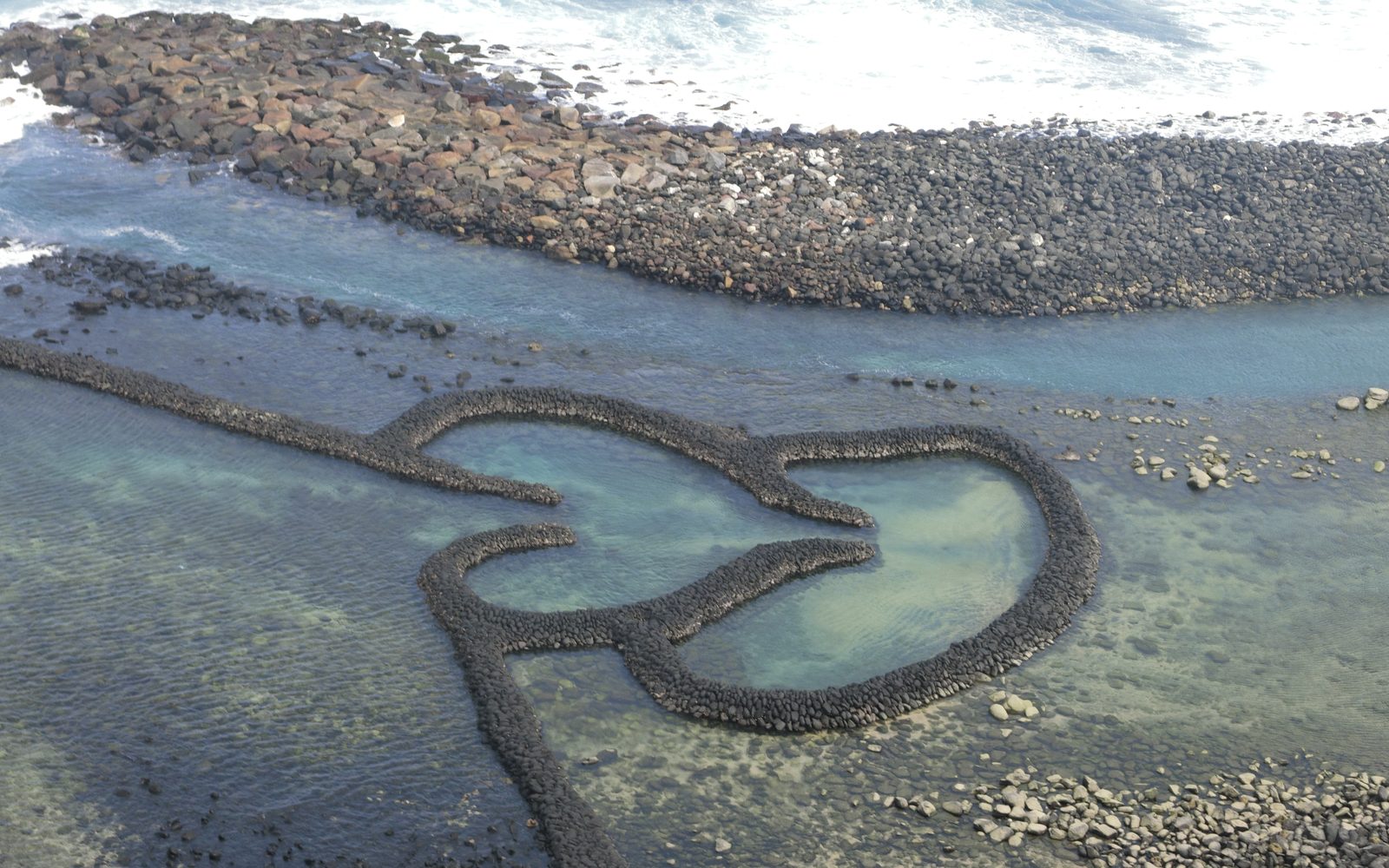
A stone weir is a traditional tidal fish trap built from basalt boulders and coral blocks. The Twin-Hearts Stone Weir (雙心石滬) on Qimei is the best-preserved example among Penghu's numerous stone traps, curving into two linked heart shapes that catch fish as the tide recedes. Because the dual hearts are fully visible only at low tide, verify the day's low tide before you go. The cliffside viewpoint above the weir is accessible at all hours.
Reaching Qimei requires a boat or flight from Magong:
- County ferry: Departs from the South Sea pier in Magong and takes about 2 hours to reach Qimei. The one-way county ferry fare is NT$437 from Magong to Qimei and NT$272 from Magong to Wang'an. The Qimei visitor center sits directly beside the ferry dock at Nanhu harbor.
- Private speedboats: Run from Magong only during the peak summer season, completing the crossing in about 70 minutes.
- Domestic flights: Daily Air operates daily flights connecting Magong, Qimei, and Kaohsiung.
Facts on this page were checked against official sources on . Hours, fares and trail status change: confirm on the day.