Matsu: blue tears, flights, the Taima ferry, and villages
Daily flights from Taipei Songshan and the overnight New Taima Ferry from Keelung run to Matsu year-round (subject to fog and sea state), while peak blue tears season runs April to June. Checked .
Matsu Islands馬祖
The Matsu Islands (馬祖) are reached by a 50-minute flight from Taipei Songshan or an overnight ferry from Keelung. Peak season for the glowing blue tears runs from April to June across the five main islands. Sightings depend on dark skies, wind, and luck, so building extra days into your trip is essential.
Blue tears season and where to look
The Matsu National Scenic Area gives April to June as the peak season for the blue tears. The glowing water is created by bioluminescent dinoflagellates, plankton that glow blue on quiet nights when disturbed by waves or wind. To see them properly, you need a dark place with no light pollution.
The scenic area's event page gives a wider window, May to September each year, with the event months listed as April to September. A sighting comes down to luck rather than planning, so the scenic area suggests adding extra days to a trip; the right tide and wind improve your chances. A 2016 study quoted by the scenic area found the plankton disappeared once the sea temperature passed 27 °C.
In season, sightings are possible on all five main islands. The scenic area points travelers to:
- Nangan (南竿): Fuao (福澳) port and Tiebao
- Beigan (北竿): Qiaozai and Tanghou Beach
- Dongju (東莒): Fuzheng Beach and Mengao port
- Xiju (西莒): Caipuao and Kunqiu Beach
- Dongyin (東引): Qingshuiao
The Beihai Tunnel night boat
The Beihai Tunnel blue tears boat tour on Nangan takes bookings for nights from March 1 to November 30 each year. It runs every night from 18:30 to 21:00, divided into six sessions a night. Each session accommodates 48 people, and the boat ride lasts about 15 to 20 minutes. Bookings open for dates within the coming month.
A full-fare ticket for the night tour costs NT$350. The NT$300 concession is reserved for children aged 3 to 12 and people aged 65 and over who hold household registration in Taiwan. Bookings are taken by the operator, Tieren Leisure & Recreation, on (0836) 22177, Monday to Saturday from 09:00 to 16:30. Visitors park at the visitor center, walk to the tunnel, and must arrive 15 minutes early to buy tickets.
Safety rules inside are strict: life jackets must be worn the whole time, and you must not stand up or change seats. There is no smoking in the tunnel, and anyone drunk is turned away. Because the blue tears are a natural phenomenon, sightings cannot be guaranteed; if force majeure cancels a tour, the fare is refunded in full.
By day, Nangan's Beihai Tunnel opens from 08:00 to 17:00, but entry depends on the tide, so check the tide table or ask the visitor center first. On Dongyin, Beihai Tunnel is currently closed, and visitors must not enter it. On a cloudy night, the Matsu Blue Tears Ecological Museum on Nangan's main tourist route is open daily from 09:30 to 12:00 and 13:30 to 17:00.
Flying from Taipei
Flights to Matsu depart from Taipei Songshan, Taichung, and Kaohsiung, landing at either Nangan or Beigan. From Taipei, the flight takes about 50 minutes. Between Songshan and Nangan, UNI Air flies around six round trips a day and Mandarin Airlines operates around one. Between Songshan and Beigan, UNI Air flies around three round trips a day.
The scenic area gives the one-way fare from Songshan to Nangan or Beigan as about NT$2,197, excluding insurance. Passengers must check in at least 30 minutes before departure and carry valid identification such as a passport. Strong winds or fog can delay or cancel flights to Matsu, so confirm your flight before setting out.
The overnight ferry from Keelung
For a sea voyage across the waters from northern Taiwan, the New Taima Ferry sails from Keelung to Nangan and Dongyin, taking about 8 to 10 hours; the Taima Star shares the route. The ship runs a triangle, calling at Nangan first on some days and Dongyin first on others, with about 2 hours of sailing between the two islands. Check which way your sailing goes before boarding.
In Keelung, the ferry departs from the West Passenger Terminal, located about 50 meters from Keelung's North railway station. Keelung itself connects easily to rail links explained in our guide to getting around Taiwan. It is an overnight sailing: ticket sales run at Keelung's West 2 wharf from 20:00 to 21:30, and departure is at 22:30. On days when the ship calls at Nangan first, the schedule reaches Fuao port at 07:00. Because the voyage is long, arrival times can vary by about 30 minutes either way, and sea conditions can delay it further.
Fares differ slightly by direction due to local tax:
- Keelung to Matsu (tax included): NT$630 for an economy seat, NT$1,050 for an economy bunk, and NT$1,575 for a bunk in a four-berth cabin.
- Matsu to Keelung (no tax): NT$600 for an economy seat and NT$1,000 for an economy bunk.
Children under 12 and passengers aged 65 and over travel half price upon showing ID when buying tickets and boarding. You can book by phone or online up to 60 days before departure. Always bring photo identification, such as a passport, driver's license, or health insurance card. Sailings are canceled when wind or waves exceed grade 10, and departures are confirmed after 11:00 on the morning of sailing on the operator's website or by phone on (02) 24256777. Severe maritime weather during typhoon season in Taiwan will halt services entirely.
Fog season
March to May is Matsu's fog season, which makes flight and ferry schedules less certain. Call the airline and the ferry company in advance to confirm departures. When planning a spring visit during the broader best time to visit Taiwan, the scenic area advises leaving flexibility in your schedule to absorb unexpected delays.
Ferries between the islands
Travel between the islands relies on local ferries operating out of Fuao on Nangan, Baisha and Qiaozai on Beigan, Zhongzhu on Dongyin, Mengao on Dongju, and Qingfan on Xiju. You can check and book passages on the Matsu Maritime Transportation Online Booking System, though tickets for some short routes lasting 30 minutes or less are sold only at the pier. Arrive at the wharf 10 minutes before boarding. Ferry schedules adjust by season, with more sailings in summer and fewer in winter, and bad weather can cause delays. Book ahead during holidays and the summer break.
- Nangan to Beigan: Takes about 15 minutes, with an adult fare of NT$160. Boats run all year between Fuao and Baisha, daily from about 07:00 to 17:30.
- Nangan to Juguang (莒光, the township of Dongju and Xiju): Takes about 50 minutes, with an adult fare of NT$160. The boat calls at both Dongju and Xiju in an order alternating by month. Departures leave Nangan for Juguang at 07:00, 11:00, and 14:30, returning from Juguang at 07:50, 11:50, and 15:20.
- Dongju to Xiju: Takes 10 to 15 minutes, costing NT$80 for adults, with four round trips a day.
- Nangan to Dongyin: Takes about 2 hours aboard the New Taima Ferry or Taima Star, costing NT$400 for adults, with one or two sailings a day.
Like other offshore destinations in our Taiwan islands guide, boat schedules between these smaller ports depend closely on daily sea swell.
Qinbi village on Beigan
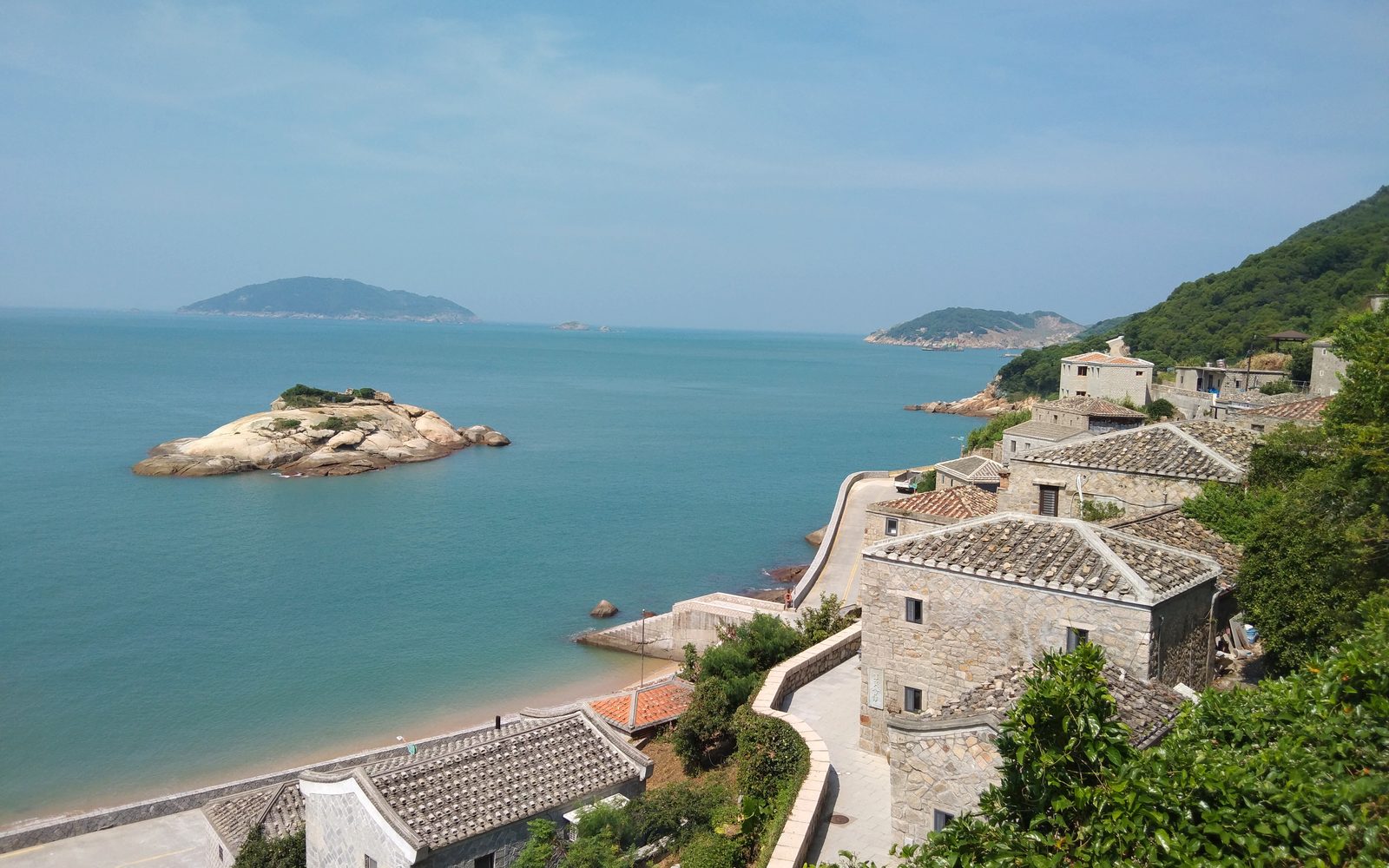
Qinbi (芹壁) village on Beigan sits at the foot of Qinshan and Bishan mountains, which gave the settlement its name. The village curves along the coast in a crescent and has earned nicknames like the "Mediterranean of Matsu" or "Little Greece".
Its narrow lanes are lined with traditional Eastern Fujian-style stone houses, each laid in a different wall pattern. Many of these granite residences now house homestays, restaurants, and art spaces. From the terraces, the village looks directly out to Turtle Island, a small rocky islet shaped like a sea turtle. Qinbi lies on the north side of Beigan, is signposted clearly from the road, and remains open all day. The local Beigan bus runs between Tangqi and Baisha, stopping directly at Qinbi.
Fuzheng and Dongju Lighthouse
The scenic area identifies Qinbi on Beigan, Fuxing and Jinsha on Nangan, and Fuzheng (福正) on Dongju as the archipelago's most interesting traditional settlements. Fuzheng village sits in Juguang township and stays open all day, with Fuzheng Beach lying an easy walk right beside the houses.
Dongju Island Lighthouse, a century-old national monument, stands on the north-eastern tip of Dongju. It is the oldest surviving Western-style stone lighthouse in Taiwan, featuring a round tower built of granite. Along the exposed hillside paths, a low stone wall measuring 130 cm high runs down the slope as a windbreak, designed so lighthouse keepers could walk safely between the light and the office during heavy gales. The grounds are open all day, with buildings accessible as posted. At night, the dark grounds make a prime spot for stargazing and moon-watching.
Fish noodles and red rice wine
Fish noodles are a signature Matsu dish, made primarily from eel or a local fish. The fish meat is minced, blended with flour into dough, baked, sliced into noodles, and dried under the sun. Locals serve them stir-fried, simmered in hot broth, or deep-fried as a crispy snack.
In earlier days, every household in Matsu brewed its own rice wine. Matsu aged rice wine uses glutinous rice, red yeast, and koji, giving it a mellow, medicinal aroma used throughout everyday home cooking. Rice wine vermicelli soup—highlighted by the scenic area as a must-try—features a rich broth flavored with aged wine, topped with a poached egg, slices of red yeast pork, and delicate vermicelli. Red yeast fried rice makes delicious use of the leftover red lees from the wine-brewing process.
Food and drink venues are clustered strictly in the main villages: Jieshou (Shanlong), Magang, and Renai (Tieban) on Nangan; Tangqi on Beigan; Zhongliu and Lehua on Dongyin; Dapu on Dongju; and Qingfan and Tianwo on Xiju.
Getting around and staying
Nangan and Beigan run public bus routes linking the settlements for a flat fare of NT$15 per ride. Taxis run on meters; for charter sightseeing, the scenic area quotes rates of about NT$500 an hour or NT$1,500 for a half day.
Most accommodation across Matsu consists of local homestays scattered through the island villages. Because overall bed capacity is limited, book your rooms well ahead of arrival.
Facts on this page were checked against official sources on . Hours, fares and trail status change: confirm on the day.